
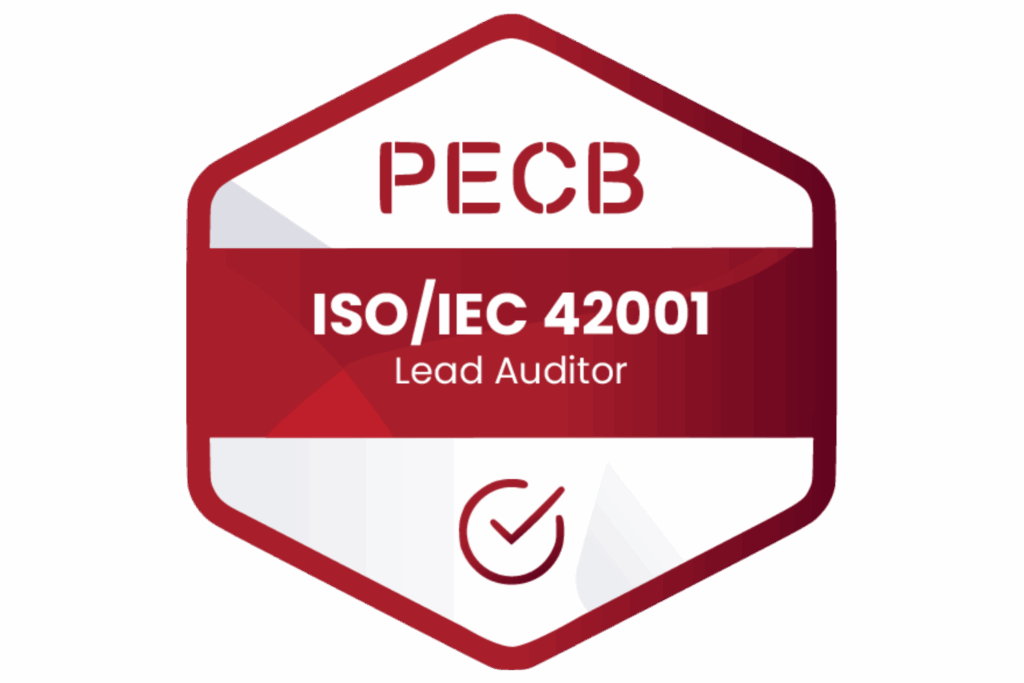
ISO/IEC 42001 Lead Auditor (PECB)
The ISO/IEC 42001 Lead Auditor training course prepares you to plan, conduct, and manage comprehensive audits of an Artificial Intelligence Management System (AIMS) in accordance with the ISO/IEC 42001 standard. It is designed for professionals who wish to validate their skills in auditing AI systems and obtain the internationally recognized PECB certification.
1. Why should you participate ?
The training helps you to :
- Understanding the requirements of ISO/IEC 42001 related to the audit of an EMS
- Conducting internal and external audits effectively
- Assessing the performance, compliance, risks, and governance of an AI system
- Outline all the stages of an audit : preparation, execution, reporting, and follow-up
- Obtain the PECB Certified ISO/IEC 42001 Lead Auditor international certification
It is essential for professionals involved in the evaluation and certification of responsible AI systems.
2. Who is this training intended for ?
The training helps you to :
- Internal or external auditors
- AI Compliance, Risk, and Governance Officers
- Consultants specializing in audit and certification
- SMIA Project Managers
- Professionals interested in becoming ISO/IEC 42001 certified auditors
OPCO eligibility
Terms and conditions
Program duration
Opening hours
Validation
PECB Exam
3. Learning objectives
Upon completion of the training, you will be able to :
- Manage an audit program for the AI management system
- Assess the compliance of an AI management system with regulatory requirements
- Interpreting the requirements of ISO/IEC 42001 from an auditor’s perspective
- Plan, conduct, and close an ISO/IEC 42001 compliance audit in accordance with ISO 19011 and ISO 17021-1
- Explain the fundamental concepts and principles of an AI management system in accordance with ISO/IEC 42001
4. Educational approach
The training combines :
- Structured theoretical content
- Case studies and real-world audit exercises
- Mock audits
- Quizzes and practice exams aligned with PECB requirements
5. Are there any prerequisites ?
A basic understanding of the ISO/IEC 42001 standard and the principles of AI is required to effectively participate in this training.
6. Training program
The training takes place over 4 days :
1° First day
Introduction to the Artificial Intelligence Management System and the ISO/IEC 42001 Standard
2° Second day
Audit Principles, Preparation, and Launching an Audit
3° Third day
On-site audit activities
4° Fourth day
Conclusion of the audit
7. PECB Certification exam
The exam lasts 3 hours and covers the following areas :
- Fundamental Principles and Concepts of an AI Management System
- Requirements for an AI Management System
- Fundamental Concepts and Principles of Auditing
- Preparing for an ISO/IEC 42001 audit
- Conducting an ISO/IEC 42001 audit
- Completion of an ISO/IEC 42001 audit
- Management of an ISO/IEC 42001 audit program
Earning the PECB Certified ISO/IEC 42001 Lead Auditor designation demonstrates your ability to conduct and lead comprehensive OHSMS audits at both the national and international levels.
8. Additional training
To strengthen your expertise :
These programs will enhance your expertise in governance, compliance, and the management of AI systems.
9. FAQ
1) What is an ISO/IEC 42001 audit ?
This is a formal assessment of an Artificial Intelligence Management System (AIMS) to verify that it meets the requirements of the ISO/IEC 42001 standard : governance, transparency, risk management, performance, security, and AI ethics.
2) How do I become an ISO/IEC 42001 Lead Auditor ?
You must complete an accredited training program (such as the one offered by PECB), pass the official exam, and demonstrate practical experience in auditing or management systems.
3) What is the difference between a Lead Implementer and a Lead Auditor ?
- The Lead Implementer establishes the AI Governance Framework.
- The Lead Auditor assesses the framework’s compliance and leads internal or external audits.
The two roles are complementary within the AI governance cycle.
4) What skills are assessed in the PECB ISO/IEC 42001 Lead Auditor exam ?
Audit planning, conducting interviews, AI risk management, evidence collection, compliance analysis, drafting audit reports, and team management.
5) What does the SMIA entail according to ISO/IEC 42001 ?
It covers :
- AI governance
- Risk and impact management
- Transparency and documentation
- AI system lifecycle management
- Human oversight and data quality
- Continuous improvement
6) What AI-related risks should be analyzed during an audit ?
Risks :
- Algorithmic bias
- Security and privacy
- Performance drift
- Model opacity
- Data dependency
- Ethical and societal impacts
- ISO/IEC 42001 requires a structured and ongoing analysis.
7) Are generative AI systems (such as ChatGPT) covered by ISO/IEC 42001 ?
Yes. The standard covers all types of AI : analytical, predictive, generative, and assistive. The audit assesses the governance, security, transparency, and risks associated with these models.
8) Is ISO/IEC 42001 mandatory ?
No, but it is becoming a strategic benchmark for :
- Companies offering AI services
- Oorganizations using AI on a large scale
- Companies seeking to demonstrate
- Compliance with the European AI Act
9) Is ISO/IEC 42001 related to the AI Act ?
The standard provides a framework that is consistent with the requirements of the future AI Act, particularly regarding :
- Transparency
- Risk management
- Documentation
- Impact assessment
- Audit mechanisms
- Certification is an asset for compliance
10) Are there any prerequisites ?
A basic understanding of the ISO/IEC 42001 standard and the principles of AI is required to effectively participate in this training.
10. Conclusion
The ISO/IEC 42001 Lead Auditor training course is the gold standard for anyone seeking to certify their skills in auditing artificial intelligence management systems. It enables participants to develop solid, internationally recognized expertise that is essential for the responsible governance of AI in modern organizations.